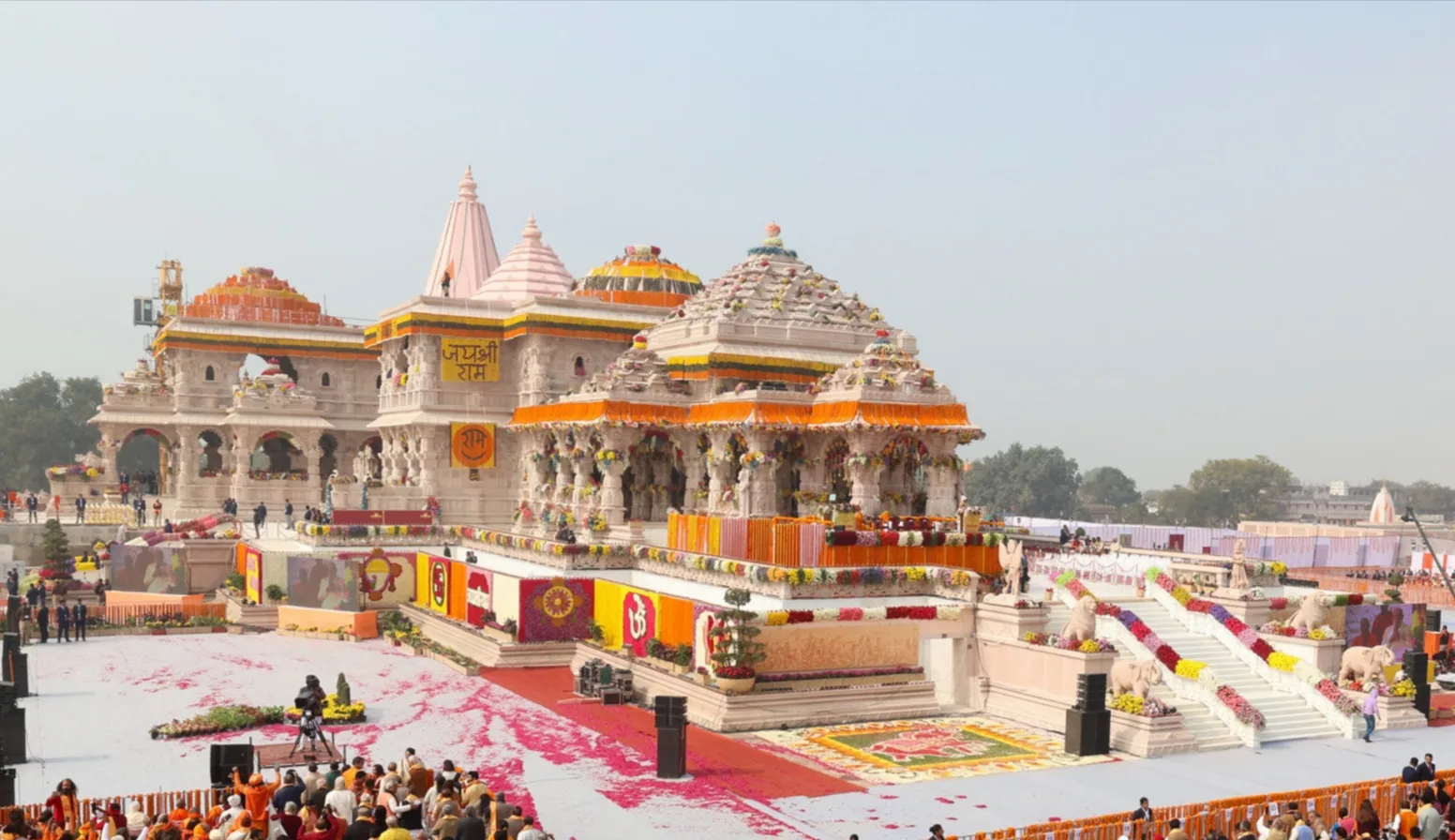
Ayodhya
Data & Research

Ram Mandir statistics & facts

Verified data on visitors, temple dimensions, construction details and Ayodhya tourism growth — updated June 2026.

All statistics on this page are sourced from official government announcements, temple trust communications, or widely corroborated mainstream media reports. Visitor figures are estimates compiled by tourism bodies. Where exact data is unavailable, ranges are shown.

Key Statistics

Pran Pratishtha (Consecration)
22 January 2024
Consecration ceremony performed by PM Narendra Modi
Source: Shri Ram Janmabhoomi Teerth Kshetra
Visitors in first year (2024)
~8–10 crore
Reported pilgrim footfall January–December 2024
Source: UP Tourism / media reports
Peak single-day visitors
~35 lakh
Ram Navami 2025 pilgrim count (March/April 2025)
Source: UP Government / media reports
Average daily visitors
50,000 – 1,00,000
Normal (non-festival) days
Source: Temple Trust estimates, media
Total temple complex area
70 acres
Ram Janmabhoomi complex total land area
Source: SRJBTKT official
Main temple height
161 feet (49 m)
Shikhara height of the main sanctum structure
Source: SRJBTKT official
Main temple footprint
380 ft × 250 ft
Ground floor plan of the main temple building
Source: SRJBTKT official
Number of pillars
392
Total carved stone pillars in the main structure
Source: SRJBTKT official
Architectural style
Nagara (North Indian)
Traditional Hindu temple architecture with Shikhara
Source: Temple architects
Primary stone material
Bansi Paharpur pink sandstone
Quarried in Rajasthan; no iron used in load-bearing structure
Source: SRJBTKT / architects
Donations received
₹3,500+ crore
Public donations to the construction fund (combined campaigns)
Source: SRJBTKT / media reports
Individual donors
~5 crore
Number of individual donors who contributed to the fund
Source: SRJBTKT

Temple Architecture at a Glance

Structural floors
3 storeys
Ground (Garbhagriha), first and second floors; each approximately 16,000 sq ft per floor.
Mandapas (pavilions)
5 mandapas
Rangmandap (entry), Nritya (dance), Rang (performance), Prarthana (prayer) and Kirtan mandapas.
Iron usage
Zero iron
No iron used in the load-bearing structure — traditional construction with stone, copper and interlocking joints.
Sanctum sanctorum (Garbhagriha)
20 ft × 20 ft
Inner sanctum housing the Ram Lalla idol. Accessible only to priests during worship.
Site significance
Ram Janmabhoomi
Built at the precise location identified as Lord Rama's birthplace — Ayodhya, Uttar Pradesh, India.
Construction supervisor
Larsen & Toubro
L&T undertook the construction on a pro-bono basis. Tata Consulting Engineers provided engineering support.

Key Milestones

November 2019

Supreme Court verdict

Five-judge bench unanimously ruled in favour of Ram Lalla; directed allotment of 5-acre alternative plot for Sunni Waqf Board.

5 August 2020

Bhumi Pujan (foundation ceremony)

PM Narendra Modi performed the bhoomi puja; cornerstone of the new temple laid.

December 2020

Construction commences

Excavation and foundation work begins under Larsen & Toubro supervision.

December 2023

Maharishi Valmiki International Airport opens

New airport (IATA: AYJ) inaugurated at Ayodhya, ~15 km from Ram Mandir; first commercial flights by January 2024.

22 January 2024

Pran Pratishtha

Grand consecration ceremony; Ram Lalla idol installed by PM Narendra Modi in the new sanctum.

March 2024

Full public opening

Temple opens to all pilgrims; 3-tier security and crowd-management system put in place.

April 2025

Ram Navami 2025

Approx. 35 lakh pilgrims attended over the festival days — largest single-festival footfall reported.

Tourism & Infrastructure Growth

IndicatorFigureNotes
Registered hotels in Ayodhya city500+Significant increase from ~50 pre-2024 (approx, UP Tourism)
Hotel rooms added 2022–202510,000+New properties under construction or opened since 2022 (approx)
Ayodhya development project outlay₹35,000 croreState + central government infrastructure investment announced for 2022–2027
Maharishi Valmiki Airport runway3,200 mCapable of handling wide-body aircraft; opened December 2023
Airlines operating at AYJIndiGo, Air India, AkasaConnecting Delhi, Mumbai, Bengaluru, Kolkata, Ahmedabad (as of mid-2026)
Ayodhya bypass road length15 km Ring Road

Visitor Context

Low crowd
Regular day
50,000 – 1,00,000

Short queues; 30–90 min wait. Best time for a relaxed darshan.

Moderate crowd
Weekend / holiday
1,00,000 – 2,50,000

2–4 hour queues typical. Arrive before 7 AM for shorter waits.

Very high crowd
Major festival
5 – 35 lakh

Ram Navami, Deepotsav. Expect 6–10+ hr waits. Book stay 2–3 months ahead.

Visitor estimates compiled from UP Tourism press releases, district administration reports and media coverage. Figures are approximations; actual numbers vary by date, season and prevailing conditions.

Statistics sourced from: Shri Ram Janmabhoomi Teerth Kshetra (SRJBTKT) official communications, UP Tourism, Government of India press releases, Larsen & Toubro, and corroborated mainstream news reports (The Hindu, Times of India, Hindustan Times, ANI). Last updated: June 2026.
Cite this page: UP Ayodhya, "Ram Mandir Statistics & Facts 2026," upayodhya.com/ram-mandir-statistics (June 2026).